An Inside Look
The election process is so much more than what voters see at the polls on election day. From mailing, receiving, and tallying absentee ballots to the work done at the polls on election day, hear from staff at the clerk's office and precinct co-chairs.
Information About Voter Registration
- First and foremost, it is the responsibility of each citizen to maintain an accurate voter registration record. However, too frequently, citizens neglect to perform this duty – at least not until an Election Day nears. In fact, we process thousands of changes in voter registration in the weeks prior to November elections.
- Importantly, citizens who properly register have a legal right to remain registered. They cannot be removed unless we receive a signed request from the voter asking us to remove them, or reliable information to challenge their registration status. If we receive the latter, the voter is afforded due process. That due process is notice and an opportunity to respond, allowing us to update their registration.
- Please know that voter registration rolls are state-based. The federal government has elected to not create a national voter registration system. This means that we are not automatically notified when you move to another state.
- All levels of Michigan government work to maintain these lists on a year-round basis in some of the following ways:
- The state compares against driver’s license records and obtains death certificates. Daily my office updates registration records based upon these sources of information.
- My office also utilizes returned election mail and returned mail from other Township business as a source of information to update registration records.
- We also review principle residence filings with the Township and if someone has removed a homestead exemption but did not change their voter registration we would mail the person a registration confirmation card asking for them to verify residency for election purposes.
- Voter registration records are maintained in a statewide database called the Qualified Voter File. It is maintained by the State, the County, and by Township/Municipal Clerks
Public Accuracy Test
Prior to every election, each Michigan municipality tests every voting machine against the ballot to be used in that election. In order for a tabulator to be placed in service for an election it must pass every test with 100% accuracy. After testing each machine is sealed and kept under lock and key until opened for Early Voting or Election Day. Except, one tabulator and one voter assist terminal is brought to the municipality's Election Commission to conduct a re-test during the "Public Accuracy Test." The video below is the most recent meeting of the Bloomfield Township Election Commission for conducting the public accuracy test.
Bloomfield Township has also twice conducted Hash testing on our Hart Equipment to confirm that the installed software matches the manufacturer's software and that approved by the federal government and the State of Michigan. All equipment has passed, as would be expected since the equipment is never connected to the internet and is only serviced by sworn election workers or official representatives of the manufacturer.
Five Steps for Federal Certification
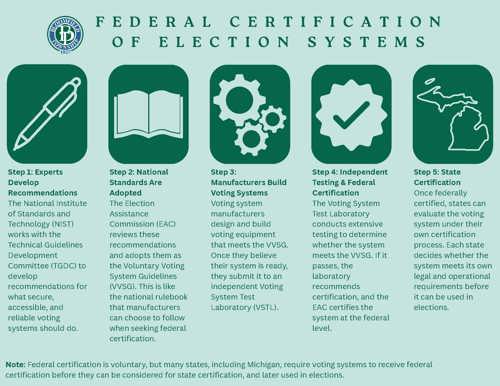
- Experts Develop Recommendations - The National Institute of Standards and Technology (NIST) works with the Technical Guidelines Development Committee (TGDC) to develop recommendations for what secure, accessible, and reliable voting systems should do.
- National Standards Are Adopted - The Election Assistance Commission (EAC) reviews these recommendations and adopts them as the Voluntary Voting System Guidelines (VVSG). This is like the national rulebook that manufacturers can choose to follow when seeking federal certification.
- Manufacturers Build Voting Systems - Voting system manufacturers design and build voting equipment that meets the VVSG. Once they believe their system is ready, they submit it to an independent Voting System Test Laboratory (VSTL).
- Independent Testing & Federal Certification - The Voting System Test Laboratory conducts extensive testing to determine whether the system meets the VVSG. If it passes, the laboratory recommends certification, and the EAC certifies the system at the federal level.
- State Certification - Once federally certified, states can evaluate the voting system under their own certification process. Each state decides whether the system meets its own legal and operational requirements before it can be used in elections.
Learn More
The Michigan Department of State/Secretary of State has additional information on the security of Michigan elections.