
With the growing use of mobile devices the Township recognizes the need for expanding its cell service infrastructure. Currently there are several pockets within the Township where cellular service is weak or non-existent. Reliable infrastructure is one of the priorities of the Strategic Plan, the Township is taking steps to address these high-need areas. The Township is moving from a passive to proactive approach and is working with the Bloomfield Township community and small cell providers to understand everyone's concerns.
Planning for Improvement
In an effort to address cellular reception, Bloomfield Township hosted cellular providers, their small cell contractors, and DTE at their first-ever small cell open house on Wednesday, February 25, 2026. Residents also attended and viewed an enlightening presentation about the application process for perspective providers, gap areas of service and the infrastructure needs. The event concluded with a “Q&A” portion where residents were able to address concerns about local cell coverage issues. The event proved to be very effective. More than a dozen new permits were submitted the following day by Verizon.
Upcoming Actions
As a result of the Open House, The Township was able to outline several next steps:
- Streamline the permit process for small cell providers through ordinance updates and permitting improvements.
- Encourage provider investment in high-need areas.
- Coordinate with utilities for pole infrastructure.
- Ensure aesthetics of poles and facilities are not disruptive to the environment.
- Track cellular coverage and its progress.
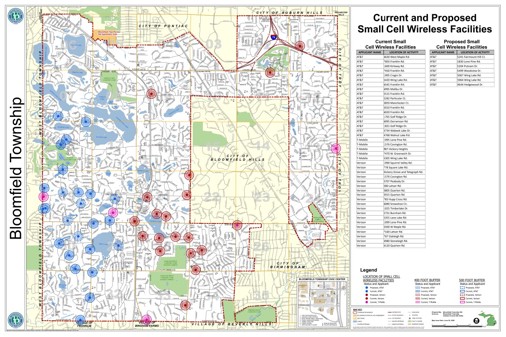
This map identifies the coverage gaps and the short-term proposed expanded coverage. Currently there are five (5) T-Mobile small cell wireless facilities and three (3) Verizon small cell wireless facilities. The additional facilities proposed include 24 AT&T facilities and 16 Verizon facilities, that would be strategically placed throughout the Township.
Click to enlarge or print.
Timeline
Residents can expect continued resident engagement on this issue and more annual engagement events like the one in February.
Frequently Asked Questions
Small cell wireless facilities contain telecommunication equipment like antennas and radios, and are attached primarily to existing infrastructure such as public streetlights, traffic signal poles or utility poles. Because small cells are capable of transmitting a large amount of data at high speed over a small area, they are a solution to provide data capacity relief for densely populated areas as demand continues to surge. Federal Communications Commission (FCC) defines small cell facilities as low-powered wireless base stations that typically provide coverage for targeted indoor or localized outdoor areas ranging in size from homes and offices to stadiums, shopping malls, hospitals and metropolitan outdoor spaces. The installations of this equipment help wireless carriers add capacity to their networks to provide better access to cell phone coverage and high-speed wireless data services.
State and federal laws regulate wireless infrastructure that is deployed within city right-of-way. The State owns and operates these rights of way (e.g., streets, sidewalk, alleyways, etc.) and regulates construction that occurs within the right-of-way. Wireless carriers must apply for a permit to construct small cell wireless facilities within the State's rights-of-way. The State will assess applications for permits to install new or alter existing wireless facilities and ensure sites adhere to city regulations and standards. Several examples of these standards reviewed by the State include safety, and aesthetics. The State authorizes access to public rights- of-way, and may impose fees upon wireless carrier to install or modify small cell wireless facilities within the right of way.
The State is not involved, and does not dictate, plan, or require where small cell wireless-way, and require that deployment of wireless facilities are done in a manner that protects the facilities will be placed in the right-of-way or on private property. The State does not participate, in any way, in how, when, or where small cell wireless facilities will be deployed in the right-or-way or on private property. By law, the State’s only function is to regulate usage of its rights-of health, safety, and welfare of the community.
Oversight of wireless siting is largely established from three federal laws.
These federal laws are designed to stimulate wireless infrastructure development and limit local authority that might frustrate that development. Most recently, in September 2018, the Federal Communications Commission (FCC) issued FCC-18-133 that interprets federal law governing small cell wireless facilities to further remove barriers to wireless infrastructure deployment In 2018, Michigan adopted legislation (the Small Wireless Communications Facilities Deployment Act) granting right-of-way access to wireless providers to deploy technology known as small cell.
Small cell wireless facilities can be located in public rights-of-way and easements.
In most cases, existing streetlights are removed and replaced with a new pole with a streetlight an antenna, ground equipment, and an electric meter pedestal.
- On traffic signal poles.
- On other city structures in the right-of-way, i.e., bus stops, benches, etc.
- On existing, non-city owned utility poles.
- On new, freestanding poles in the public rights-of-way, unless existing infrastructure is technically feasible.
- Small cell wireless facilities can be strand mounted on existing overhead cables.
The locations of small cell site are not chosen by the State, nor does the State participate in siting decisions beyond zoning requirements. The locations of small cell sites are chosen solely by the carriers.Small cell wireless facilities can be located in public rights-of-way and easements.
In most cases, existing streetlights are removed and replaced with a new pole with a streetlight an antenna, ground equipment, and an electric meter pedestal.
- On traffic signal poles.
- On other city structures in the right-of-way, i.e., bus stops, benches, etc.
- On existing, non-city owned utility poles.
- On new, freestanding poles in the public rights-of-way, unless existing infrastructure is technically feasible.
- Small cell wireless facilities can be strand mounted on existing overhead cables.
The locations of small cell site are not chosen by the State, nor does the State participate in siting decisions beyond zoning requirements. The locations of small cell sites are chosen solely by the carriers.
The FCC requires all FCC-regulated transmitters, including small cell, to comply with its radio frequency exposure standards. The FCC sets RF emissions limits in close consultation with the FDA and other health agencies. Compliance with these guidelines ensures exposure levels remain well below those generally believed to cause adverse health effects. The FCC’s authority and responsibility to set RF emissions levels for FCC-regulated transmitters is found in the National Environmental Policy Act of 1969. FCC rules governing RF emissions exposure are contained in 47 C.F.R. §§ 1.1307, 1.1310. For more information, please visit the FCC’s web page on Radio Frequency Safety. Questions or concerns regarding human exposure to RF emissions from FCC-regulated transmitters can be directed to:
Federal Communications Commission
Consumer & Governmental Affairs Bureau
445 12th Street SW Washington, DC 20554
phone 1-888-225-5322
Yes. Michigan State law allows for a new, replacement or modified utility pole (i.e., a communications pole, electric distribution pole, light pole, or traffic pole) to be placed in the right-of-way as long as the pole is: no more than 40 feet above ground level, unless a taller height is agreed to by the relevant authority. MCL 460.1313(5)(a).
Yes. Michigan State law allows replacement of a small cell facility on an existing utility pole or wireless support facility (i.e., any structure other than a utility pole such as a monopole, tower, sign or billboard, or any structure supporting a wireless facility) along with existing small cell facilities as long as the new facility does not extend more than 5 feet higher than the pole or wireless support structure. MCL 460.1313(5)(b).
No. The new FCC regulations apply to small cell site facilities located within the right-of-way. The large, traditional lattice structures are not subject to the new FCC rules for small cell facilities and are subject to all the typical land use, zoning, engineering, and development requirements from the City.
No. The federal and state laws regulate small cell wireless facilities constructed in the right-of-way. MCL 460.1301. These laws do not regulate small cell facilities constructed on private property, and wireless providers must obtain the permission of the property's owner.
No. Under federal and state law, the State does not regulate or require the number of cell facilities that are installed within the city, but the State may impose some restrictions limited to protecting the public's health, safety, and welfare of the people.
Federal law mandates a 60-day “shot clock” to begin when a completed application is submitted. State law requires a small cell wireless facility to be completed within 1 year from the date a permit is granted. MCL 460.1315(l).
The wireless provider(s) who installed the site are responsible for operation and maintenance of the site. While the public streetlights are owned and maintained by the city, the upkeep of the small cell sites is the responsibility of the wireless providers. All installations are required to have labels identifying the provider and a 24-hour contact number. If you have concerns regarding the operation of a cell site, contact the carrier.